
About J.R. Lince-Hopkins
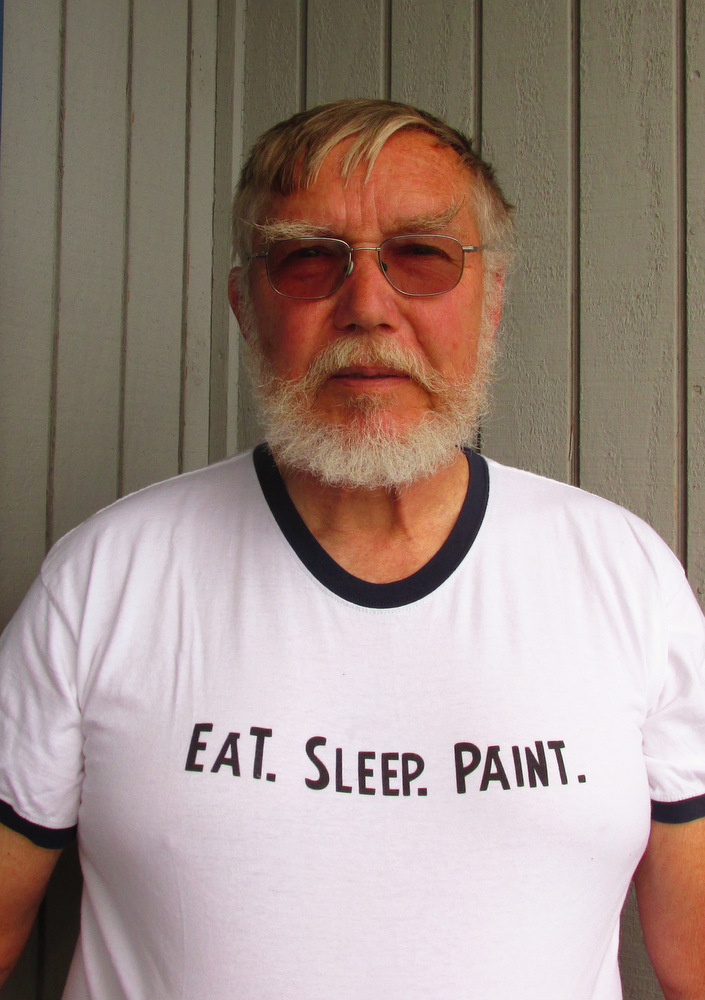
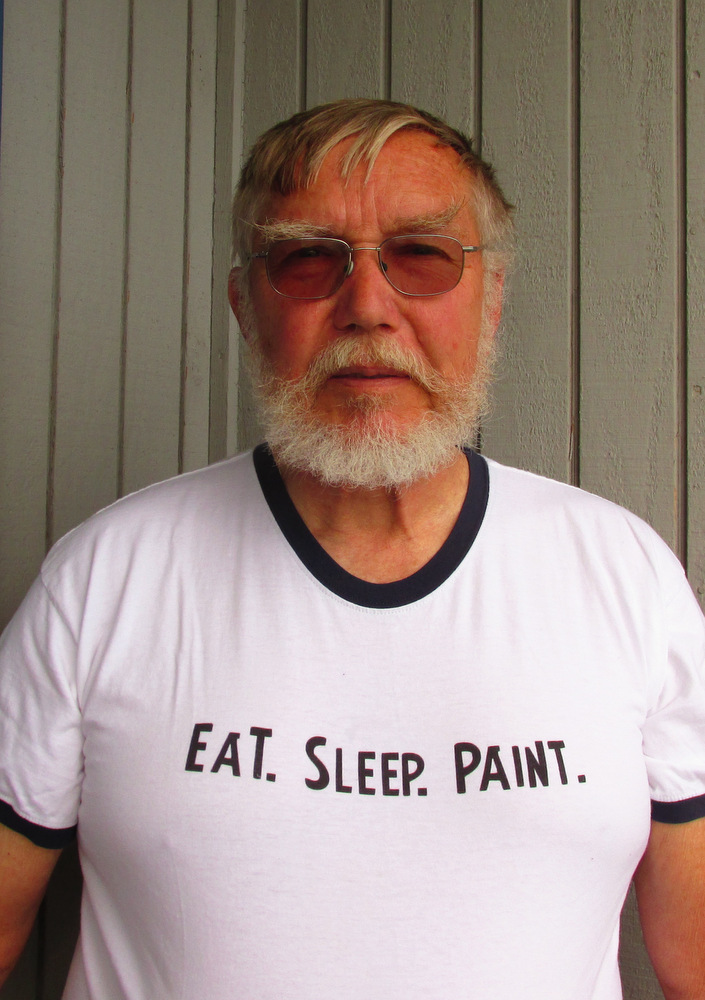
I have lived and painted in several parts of the United States and currently live on the South Shore of Lake Superior. With time-of-the-first-awareness eyes, I now paint landscapes, skyscapes, and lakescapes to record our grand and changing environment. As increasing weather extremes and the onset of climate induced changes occur in our world, many artists like me are documenting these events for future generations to ponder.

About J. R. Lince-Hopkins (John)
Born to a military family in 1948, John grew up in Europe, Japan, and several regions of the United States. From his earliest memories, the world has been perceived as dancing light, visual images, color, and forms. While in Europe, as a very young child, his family frequently visited the great museums and opera houses. As a youngster in Iramagawa, Japan, he was privileged to study oil painting and European Impressionism with a private tutor for 3 years.
Public school art classes and science classes enlivened his mind. Following high school, he studied Zoology and Ecology at the undergraduate and graduate level. Later, as a teacher and Field Biologist, he took university level drawing and painting classes (as time would allow) at the University of Alaska, Anchorage and LSU, Baton Rouge. Teachers such as Millard Sheets, Judi Betts, Robert Bateman, Richard Stroud, Mike Crespo, and Dr. John P. O’Neill (LSU) greatly influenced him and brought his dual career paths of art and science into sharp and harmonious focus.
His original oil paintings are accomplished with a palette knife or fingers.
He and his collaborator, colleague, and wife, Susan Lince, now have a home, studios and galleries in Washburn, Wisconsin. His original oil paintings are accomplished with a palette knife or fingers.
Artist Statement:
Those of us who watch and wonder about the extraordinary pageant of nature are aware of the central role that skies play in our perceptions. As artist John Constable observed in the early 1800s, the mood and content of the sky is what sets the overall mood of a painting. Ojibwa artist George Morrison once said that “the colors of the wind” were some of what he wanted to understand as an artist. Eric Sloane painted majestic paintings of clouds over landscape and gave us the multi-story masterwork of towering cumulus in the Foyer of the Smithsonian’s Air and Space Museum.
To extend Constable’s, Morrison’s, and Sloane’s ideas, the random and abstract shapes, forms, and colors of weather, especially clouds, are important observations for today’s artists. To depict such random and fluid characteristics in a realistic manner is working in that space between the two great movements of abstract and realism (nonobjective and objective).
Weather, and especially clouds, may well be said to be the “voice” of climate over long periods of time. Physical factors such as proximity to bodies of water, mountains, and latitude combined with variables such as rainfall and temperature give rise to long term regional climates. Seasonally, heat is dispersed through the atmosphere causing various forms of clouds and resulting weather.
Since the early 21st Century a global understanding that the Earth is a finite ecosystem has become a part of the awareness of many humans. It is, in a full sense, the first time in human history that a significant portion of the human race has become aware of this fact in unison! Historically, future generations may well look back and recognize this period as the “Time of the First Awareness”.
I have lived and painted in several parts of the United States and currently live on the South-shore of Lake Superior. With time-of-the-first-awareness eyes, I now paint landscapes, skyscapes, and lakescapes to record our grand and changing environment. As increasing weather extremes and the onset of climate induced changes occur in our world, many artists like me are documenting these events for future generations to ponder.